Case story

ACCESS AI Assistant

An AI support agent that reads live system data

  • AI agents
  • MCP servers
  • Evaluation
  • UX design
  • Open source
See the code on GitHub
The ACCESS AI Assistant launcher: a speech bubble that says Ask me about ACCESS! next to the round button with the ACCESS arrow
Client
NSF ACCESS
Funding
NSF award OAC-2138286
Years
2024 to present

The goal

Good answers need the docs and the live system at once. ACCESS researchers ask questions that mix the two: how to request a GPU allocation, and which GPU systems are up today. Documentation answers the first half. The second lives in allocation, status and resource systems that a documentation chatbot cannot see.

When an assistant cannot see live data, it either guesses or sends people to file a ticket. ACCESS support handles more than 10,000 tickets a year.
Which GPU systems can I get time on, and which are up today?

Our approach

One agent, documentation plus 11 live data sources. We built a support agent that answers ACCESS documentation questions and live questions in the same conversation, like which GPU resources are available or what is down for maintenance.

For ACCESS it runs on an open model hosted by a partner university. Programs whose policies allow it can use commercial models instead.

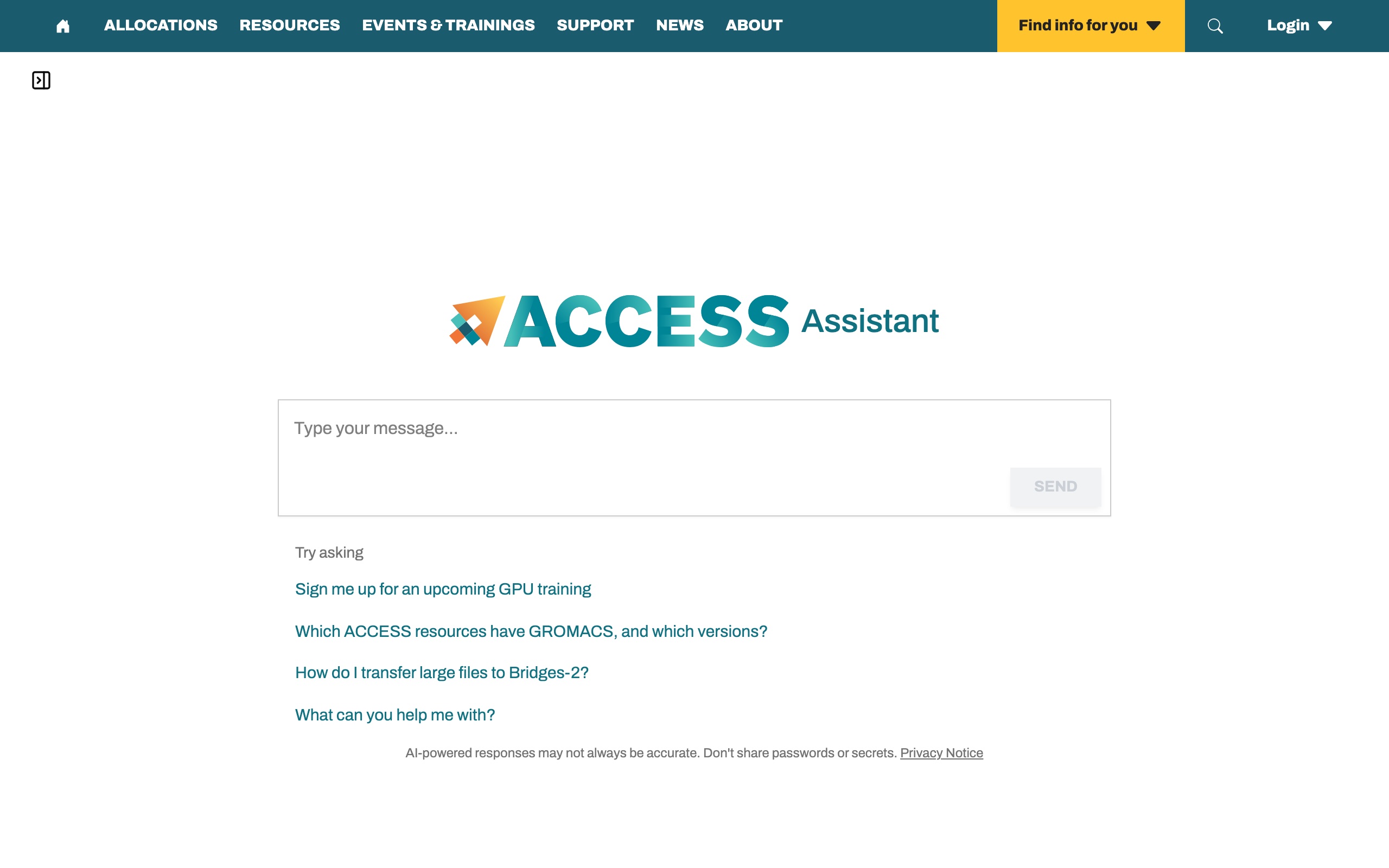
The ACCESS AI Assistant start screen, with the ACCESS site navigation above a single message box (open full size)
The ACCESS AI Assistant, full screen at qa.access-ci.org

Support agent

From a question to a checked answer. Every question goes through the same steps:

  • A researcher asks in plain language, mixing how-to and right-now questions
  • The agent plans which sources the question needs
  • It reads the documentation and the live data
  • It gives one answer, with live facts and documentation together
  • If it cannot help, it opens a ticket for a person
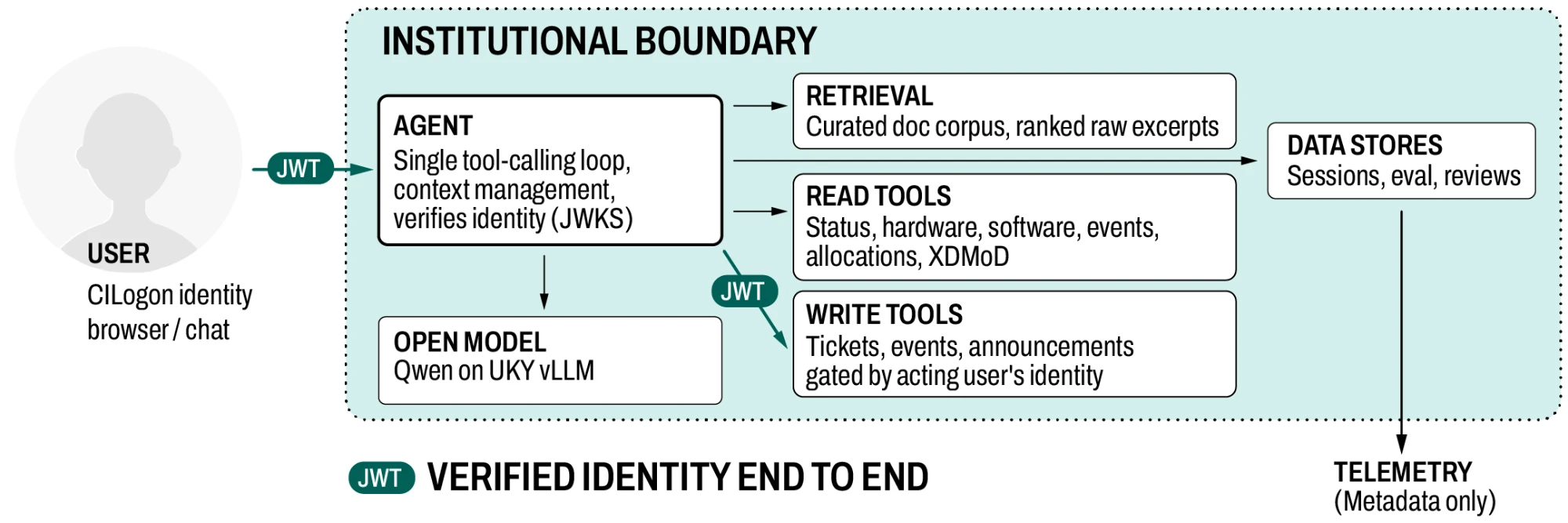
Architecture diagram. A user signs in with CILogon in the browser or chat, and a verified identity token (JWT) passes to the agent: a single tool-calling loop that manages context and verifies identity. The agent uses an open model, Qwen on the University of Kentucky's vLLM; retrieval over a curated documentation corpus; read tools for status, hardware, software, events, allocations and XDMoD; and write tools for tickets, events and announcements, gated by the acting user's identity token. Sessions, evaluations and reviews go to data stores. Everything sits inside an institutional boundary, and only metadata telemetry leaves it. Verified identity end to end. (open full size)
How the agent works: the researcher's verified identity flows through to the tools that act, and the model, retrieval and data stores stay inside the institution. From the HUST @ SC26 paper.

11 MCP servers

Live ACCESS data, open to any AI tool. Each server connects the agent to one ACCESS system. They are public at mcp.access-ci.org, so researchers can add them to Claude themselves:

  • Allocations
  • Compute resources
  • System status
  • Events
  • Announcements
  • Software
  • Affinity groups
  • NSF awards
  • Usage charts
  • Usage data
  • Ticketing
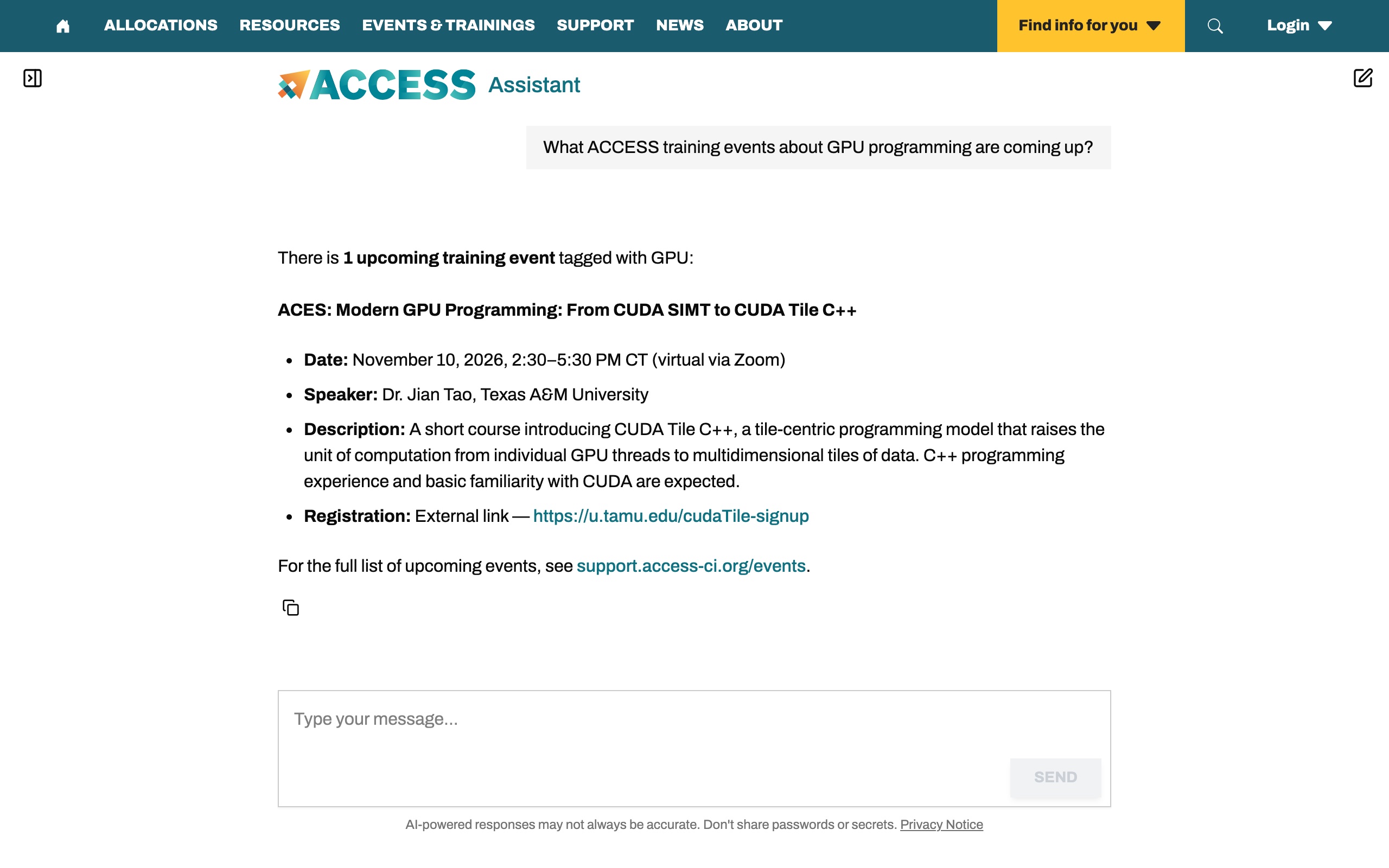
The ACCESS AI Assistant listing an upcoming GPU programming course on November 10, 2026, with speaker, description and registration link (open full size)
Example: upcoming GPU training, read live from the ACCESS events server

From answering to acting

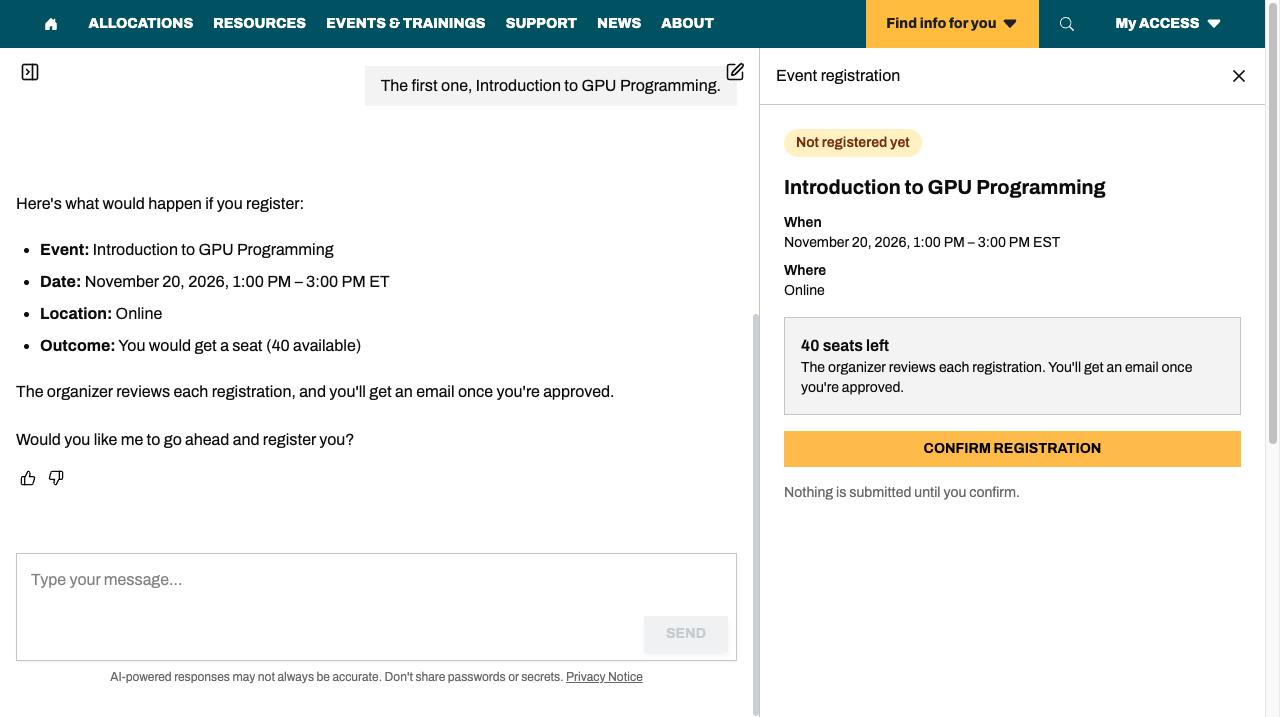
It can register a researcher for a training. Asked to sign someone up for a training, the agent finds the event, checks the seats and shows exactly what would happen. Nothing is submitted until the researcher confirms, and the registration is made under their own signed-in identity, just as if they had used the events portal themselves.

The ACCESS AI Assistant with an Event registration side pane for Introduction to GPU Programming: not registered yet, 40 seats left, and a Confirm registration button with the note Nothing is submitted until you confirm (open full size)
Example from our test environment: the agent explains, and the researcher confirms in the side pane.

How we test it

Tested on real questions, checked by experts. An answer can sound right and still be wrong. A researcher asked whether a system would be up next week. An assistant that only read the documentation said it was fully operational, but maintenance had just been postponed. Our agent checked the live status feed and got it right.

We grade every answer on the facts it contains, and the process also catches errors in the documentation itself, which go back to the team that owns the page. The full method and results are in the paper below.

  1. Staff write questions and the facts a good answer must include
  2. The agent answers every question
  3. A judge checks each answer, fact by fact
  4. Reviewers check the judge, without seeing its scores
  5. The change ships only if answers hold up

Where it is today

In use at ACCESS, and ready for other programs. The agent answers ACCESS researchers today, full screen at qa.access-ci.org and in the Q&A widget on support.access-ci.org. For ACCESS it runs on an open model hosted by the University of Kentucky, so researchers' questions never go to a commercial AI provider.

The agent and its MCP servers are open source. A program with its own documentation and systems can start from the same code, and the same evaluation keeps the answers honest as it grows.

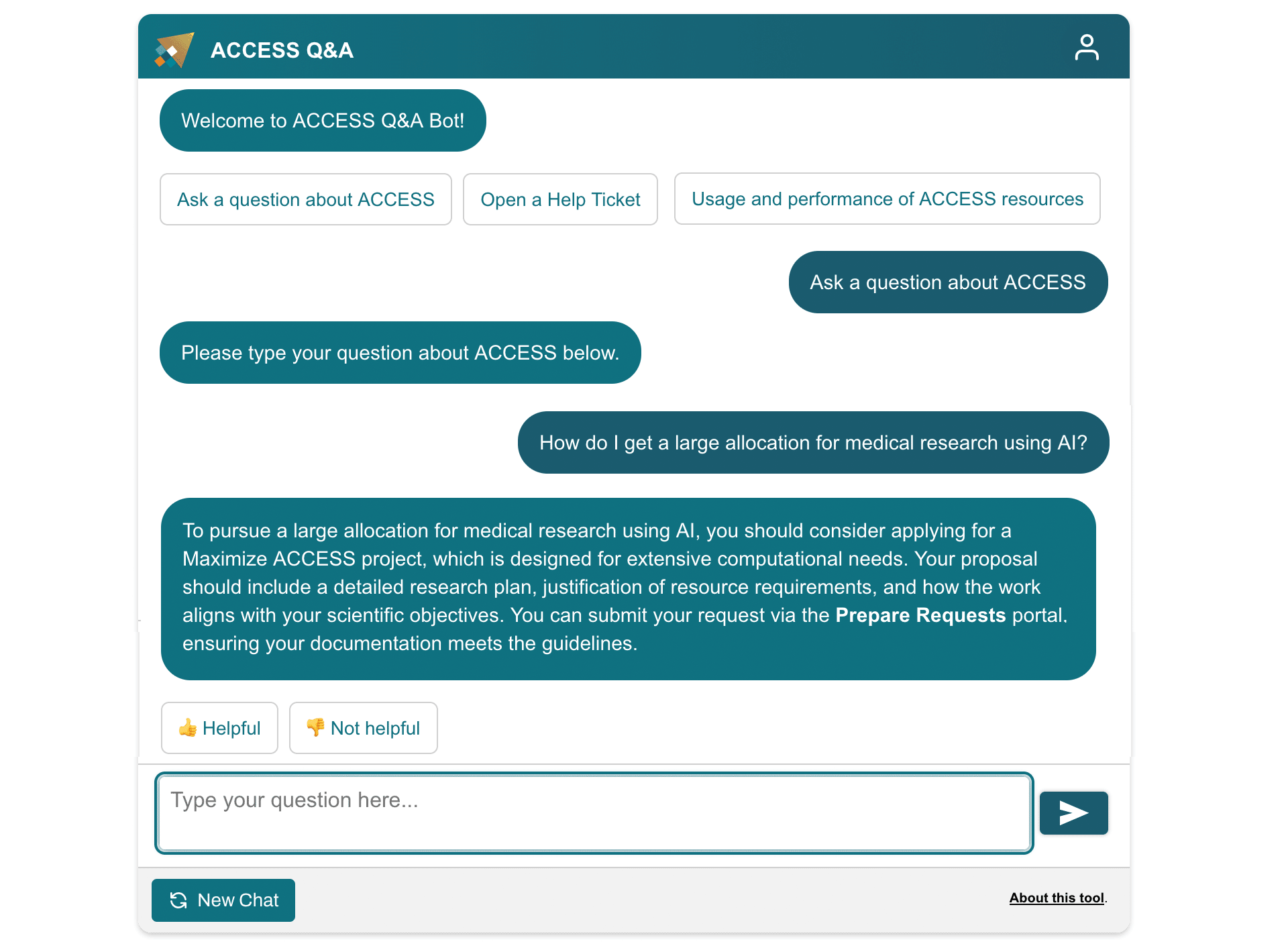
The ACCESS Q&A widget answering how to get a large allocation for medical research using AI, with Helpful and Not helpful buttons (open full size)
The ACCESS Q&A widget on support.access-ci.org
11 MCP servers for live ACCESS data, public at mcp.access-ci.org
2 model options: commercial or university-hosted open models
11,000 questions to the Q&A assistant, about 75% rated fully correct by reviewers

Paper · HUST at SC26 · Forthcoming

From Answering to Acting: An AI Agent for Research Computing User Support

A. Pasquale, V. Gazula, J. E. Bacal. November 2026.

Check the work

Want an agent that knows your systems?

Tell us about your documentation and your data sources. The ACCESS agent is open source, so we can start from it.

Tell us about your program Planning a proposal?